
正在加载页面…

从发现、理解到交流,让研究的每一步更进一步。
近期优质论文精选,帮你更快找到值得深读的文章。

Electronic Navigational Chart Change Classification
Electronic Navigational Charts (ENCs) are geospatial vector datasets used in maritime navigation systems that represent hydrographic and navigational information such as depths, navigational aids, traffic schemes, and hazards. A major challenge for hydrographic offices is determining whether a given chart change poses a critical or non-critical risk to maritime safety. Existing workflows rely heavily on manual review and verification, which is labor-intensive, scales poorly with the volume of incoming chart updates, and introduces inter-analyst inconsistencies. To address this challenge, we propose a method for automated classification of ENC changes. We establish a baseline encoding scheme to translate complex vector data changes into a structured tabular format for classification models. The two crucial components of the encoding scheme include a spatial context encoder to enrich the change representations with surrounding geographic features, and an ENC attribute encoder to represent nuanced attribute-value descriptions of the modified objects. We evaluate the proposed approach across two distinct operational datasets, comprising 1,308 chart pairs containing over 100,000 individual chart modifications. Tuned gradient-boosted trees leveraging the proposed encoding schemes achieve accuracies of 90% and 94% on the two datasets, yielding a 5-7% improvement over default hyperparameterized models trained on encodings without spatial context and attribute embeddings. These results demonstrate the viability of integrating machine learning into operational geospatial pipelines to improve ENC maintenance and enhance maritime safety. Finally, our experiments demonstrate the effectiveness of simple location and spatial aggregation methods, providing a foundation for evaluating more sophisticated spatial representation learning techniques for this application.

Dense-Cast: A lightweight ensemble of deep learning architectures for precipitation nowcasting
Proper short-term forecasting of precipitation is crucial in disaster management and preparedness. Nonetheless, the variability and nonlinearity of precipitation make short-term forecasting challenging for meteorologists. Moreover, capturing temporal dependencies in spatiotemporal data is a challenge in precipitation nowcasting. In this article, we introduce a lightweight deep learning model for half-hourly precipitation nowcasting. This model has been designed by incorporating the DenseNet architecture, residual connections, and transformer encoders for effective precipitation nowcasting with reduced model parameters. The North-Eastern region of India has been selected as the area of interest for our study. The region receives the highest precipitation during the months of June-September due to the monsoon season. The proposed model takes the previous five time-steps of half-hourly precipitation as inputs and predicts the precipitation in the next two half-hours. The GPM IMERG precipitation dataset with a 30-minute cadence has been used in this study for training and testing the model. The proposed architecture achieves best MAE of 0.235 millimetres, RMSE of 0.735 millimetres, and KGE score of 0.816 at an interval of 30 minutes.

Characterizing slopes for Legendrian knots
本文研究了勒让德纽结的接触特征斜率问题,建立了光滑特征斜率与接触特征斜率之间的关联准则。设 是标准接触三维球面 中纽结 的一个勒让德表示,若其同痕类由经典不变量——索恩–本尼昆不变量 和旋转数 唯一确定,则对任意非零有理数 ,只要 是 的光滑特征斜率, 即为 的接触特征斜率。该准则将纽结层面的拓扑刚性提升至勒让德范畴,为判断接触手术结果是否唯一刻画原勒让德纽结提供了有效工具。应用此准则,证明了任意非零有理数均为平凡纽结、左右手三叶结及八字结的任意勒让德表示的接触特征斜率,从而回答了Casals–Etnyre–Kegel提出的公开问题;同时给出了纽结 、 及五叶扭结 的若干勒让德表示的部分接触特征斜率范围,并通过具体反例说明并非所有非零有理数都适用于一般勒让德纽结(如某些 或环面纽结表示),揭示了接触特征性的精细依赖性。

Empirical dual volumes
本文引入了对偶Brunn–Minkowski理论中“对偶体积”的经验版本——经验对偶体积,构建了一个基于高斯矩阵与随机点采样的概率模型,用于近似和分析星体的对偶体积及其不等式性质。该模型以高斯滑块(Gaussian slabs)替代传统子空间交集,将对偶体积 表达为随机点落入这些滑块中的计数期望,并严格证明:当样本量 、滑块宽度 时,经验对偶体积经适当归一化后几乎必然收敛于经典对偶体积。进一步,文章建立了该经验泛函在Steiner对称化下的随机单调性:对任意方向 ,有 ,从而以纯概率方式导出经典的对偶等周不等式 。此外,文章推广至高阶矩不等式,证明经验泛函的 -阶矩同样在对称化下单调递增,并由此给出Busemann相交不等式 的全新证明——该证明完全避开截面体积的几何积分估计,转而依赖高斯滑块中随机点数的计数分析,显著简化了技术路径并揭示了对偶理论中概率方法的内在有效性与结构性优势。
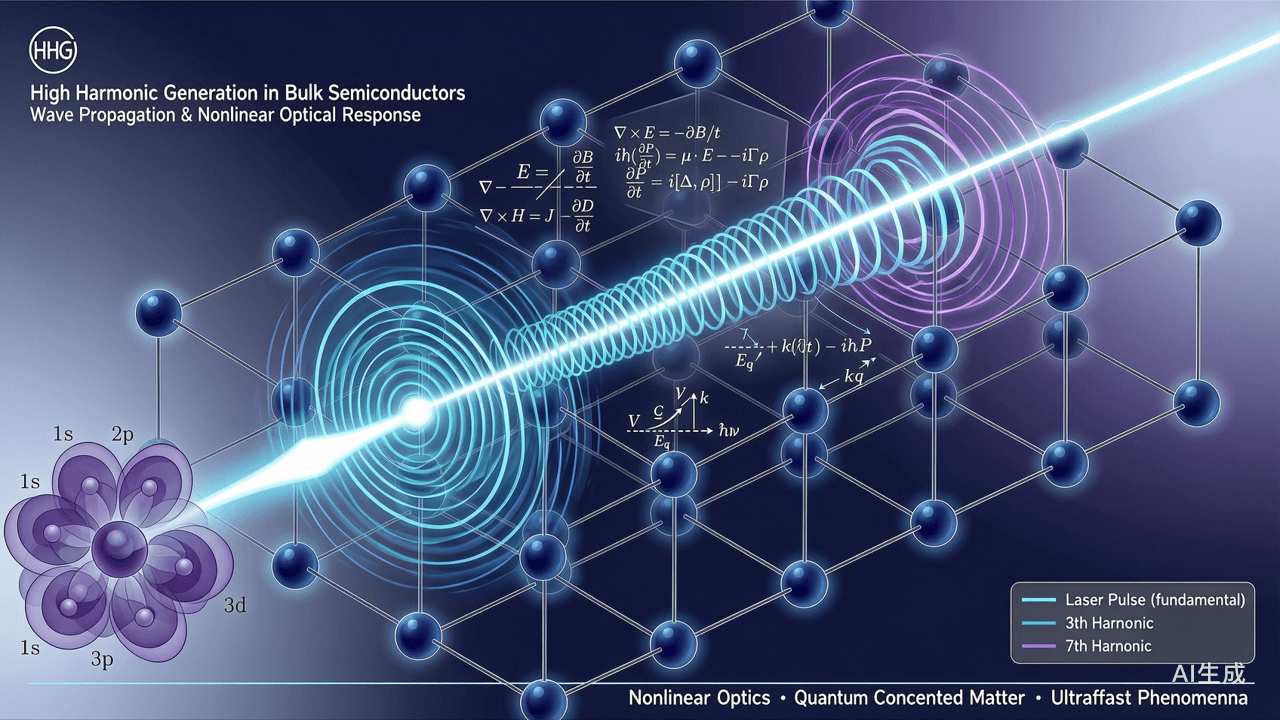
Computational Methods of Wave Propagation for Semiclassical Models of High Harmonic Generation in Bulk Solids
We present a theoretical framework for self consistent treatment of nonlinear light-matter interactions in the ultra-fast strong-field regime based on numerical solution of Maxwell’s equations and semiconductor Bloch equations. This framework is shown to describe high-order harmonic generation and propagation in bulk semiconductors, investigating differences in reflected and transmitted harmonic spectra due to propagation effects. We show that the propagation of the combined field of the driving laser pulse and generated harmonics in a bulk semiconductor significantly modifies the harmonic spectra, affecting interpretation of experimental results relating the transmitted harmonic spectra to the underlying electronic structure of the material. This model allows the self-consistent description of strong-field light-matter interactions in the non-perturbative regime, opening the way to explore the transition between fully classical and quantum regimes of interaction, tunneling and multiphoton regimes of material ionization, and perturbative and non-perturbative regimes of harmonic generation in bulk materials.

Spin-torque microwave detectors of positive rectangular pulse signals
We analyze the performance of a spin-torque microwave detector (STMD) driven by positive rectangular current pulses of various amplitudes , durations , and repetition periods and reveal two distinct regimes of STMD operation. In the first (linear) regime, the time-averaged voltage across the detector, , changes linearly with the pulse amplitude and depends on the ratio : . This regime is observed for a wide range of pulse amplitudes in the case of in-plane (IP) magnetization dynamics and for rather small pulse amplitudes in an STMD with out-of-plane (OOP) magnetization dynamics. The other (nonlinear) regime is characterized by voltage jumps and drops and is observed only in a structure with OOP magnetization dynamics for input pulses with short repetition periods and large amplitudes . We believe that the linear regime of STMD operation can be used to unambiguously detect input pulse parameters, which could be important for the development and optimization of spintronic devices capable of detecting and processing non-harmonic (e.g., digital) microwave signals.
Search for the charged lepton flavour violating decay
Based on events collected in collisions at GeV with the BESIII detector, we present a search for the charged lepton flavour violating decay with . No significant signal is observed, and an upper limit on its decay branching fraction is set to be at the 90% confidence level, improving the previous best result by nearly three orders of magnitude.
Quasinormal Modes of Gauss–Bonnet Black Holes via the Spectral Method: Scalar, Vector, and Tensor Perturbations
We present a unified study of scalar, vector, and tensor quasinormal modes (QNMs) of Schwarzschild black holes corrected by a Gauss–Bonnet (GB) term in higher dimensions. Using a high-precision Chebyshev spectral method, we map the QNM spectra across well beyond the regime where sixth-order WKB and characteristic-integration techniques remain reliable. Across the three spin sectors, we find several robust signatures of higher-curvature dynamics: the appearance of overdamped purely imaginary modes, non-monotonic behaviour in the real parts of higher overtones, and a strong amplification of the dimensionless QNM frequencies in string-motivated dimensions. In the scalar and vector sectors, we uncover an exact isospectrality between the scalar monopole () and vector dipole () at vanishing GB coupling, and we provide an analytic proof based on a Darboux factorisation of the corresponding Hamiltonians. In the tensor sector, we obtain the first numerical confirmation of the long-predicted instability in six dimensions; its onset is sharply captured by the Cohn–Calogero bound and leads to the mass threshold . No analogous instability is found for , and no tensor isospectrality occurs. Converting the dimensionless frequencies to physical units suggests that the amplified modes in higher dimensions may enter the sensitivity window of future space-based detectors such as DECIGO. The merged analysis provides a comprehensive benchmark for QNMs in Einstein–Gauss–Bonnet gravity and highlights the limitations of standard approximation schemes in the strong-coupling and high-overtone regimes.